
Awareness
Make relevant internal and external differences available to people who need to decide or act. A factory may collect many records while missing the distinction that explains a recurring defect.
Evolve Cybernetics Enhanced Candidate 1.1 is a working theory of organisational adaptive intelligence. It asks how experience becomes dependable capability, and how an organisation recognises when that capability needs to change.

An incident can create a report without changing the next response. A course can create a completion record without improving practical performance. The framework examines the route from noticing a problem to making a useful response available in daily work.
The question is what people can now recognise, understand and do; who can do it; under which conditions; and what should trigger a further review.
Make relevant internal and external differences available to people who need to decide or act. A factory may collect many records while missing the distinction that explains a recurring defect.
Interpret those differences, consider consequences and coordinate a feasible response. More data helps when it improves a relevant decision.
Make a change that persists beyond the incident: better recognition, a revised method, stronger practice, clearer coordination or useful memory. Learning can preserve a mistaken explanation, so verification matters.
Maintain or restore essential functions as conditions change, including by revising the response. It depends on the particular challenge, available resources and time.
Experience → interpretation → trial → verification → retained guidance and practice → coordinated application → new experience. The route can repeat, overlap or fail at any transition.
A procedure alone cannot supply the people, authority, equipment and time needed to execute it. Diagnosis locates the missing connection rather than assuming that more training solves every problem.
Useful memory preserves method, purpose, operating conditions, evidence, limits and review triggers. A successful response to one material or machine setting should not silently become a rule for every situation.
Obsolete guidance can leave active use while its history remains available. The organisation preserves reasoning without forcing yesterday’s answer onto today’s conditions.
Use available competence, controls and escalation to maintain essential functions.
Change the relevant skill, method, resource or working relationship where the current response is insufficient.
Improve how the organisation notices, investigates, verifies, shares and revisits its responses.
A team can restore output while leaving maintenance, replenishment, documentation or training unfinished. Those outstanding obligations can reduce readiness for the next disturbance. The framework calls this adaptation debt.
Reserve is useful when it can be mobilised in time. An alternative supplier, cross-trained operator or spare part should be assessed against the actual disturbance and deadline, rather than combined into a universal resilience score.
Suppose one defect category groups faults after material changes with faults after a long production run. Repeating the same instruction may miss two different situations.
The team improves observation categories, investigates each pattern and tests suitable responses. Experts help operators recognise cues, technical owners review methods, and employees practise the judgement. Guidance records when each response applies and when to escalate.
The gain is a better connection between recognition, action and review. Fewer defects is one possible result to examine against an agreed baseline; it is not assumed merely because a new procedure exists.
Enhanced Candidate 1.1 integrates ideas from the General Theory of Adaptive Systems 0.3. It is a developing organisational framework, not a scientifically validated universal law or an established benchmark. Its proposed contribution connects relevant awareness, experience-to-capability conversion, conditional memory and selective revision.
Here, awareness means the functional availability of relevant information for decisions. It does not claim that a factory or AI agent has subjective consciousness.
The framework informs what Evolve asks and designs. Client outcomes, measurement choices and theoretical claims each require their own evidence. Public explanations do not disclose private assessment scoring, weights or internal research methods.
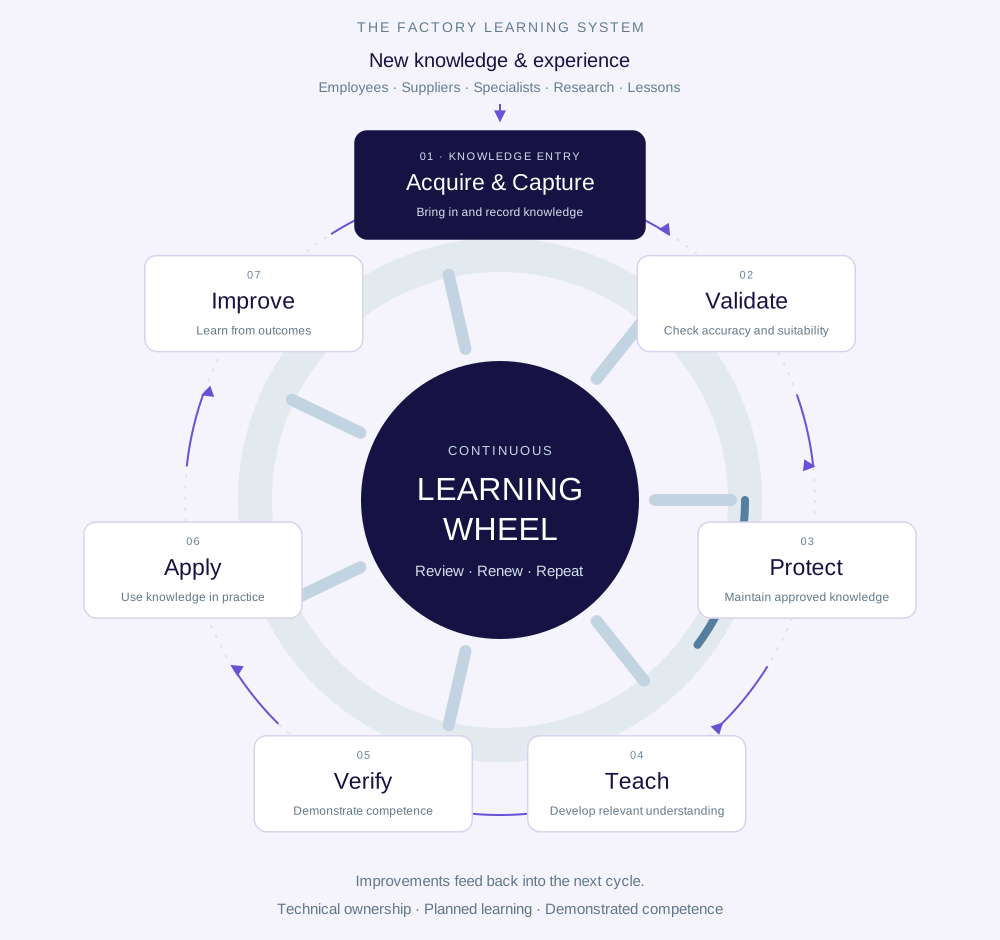
Begin with a recurring failure, a fragile capability or a change the organisation needs to absorb.