Isolated expertise
Individuals, teams or shifts hold important know-how that colleagues cannot reliably access. New employees and specialists may bring useful knowledge that remains undiscovered.
Factories depend on practical judgement as well as documented procedures. The challenge is making that knowledge reliable, accessible and usable across the people who need it.
Tribal knowledge is the practical understanding developed through experience: how to adjust a difficult setup, recognise an early defect or diagnose a failure. That expertise can be valuable while remaining hard for the organisation to reproduce.
The exposure extends beyond retirement and resignation. Knowledge may become fragmented across shifts, lose meaning during transfer, remain inaccessible in a shared drive or become obsolete while an old instruction continues to circulate. New recruits may bring useful methods that are never identified, validated or shared.
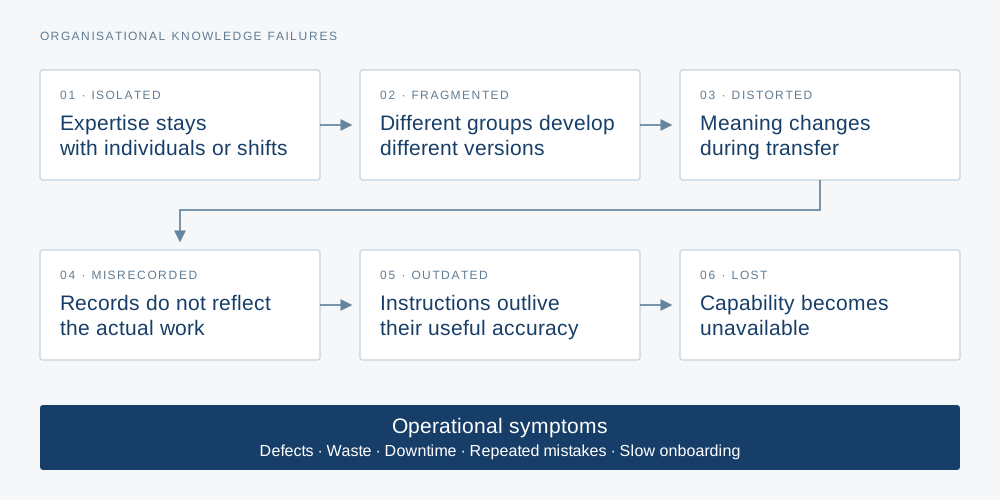
Individuals, teams or shifts hold important know-how that colleagues cannot reliably access. New employees and specialists may bring useful knowledge that remains undiscovered.
Different groups develop conflicting versions of the same practice. Instructions may be misunderstood, with assumptions replacing the reasoning behind the approved method.
Meaning degrades during transfer or operational records fail to reflect reality. Subsequent analysis may be precise but based on the wrong account of the work.
Materials remain available after equipment, risks, requirements or effective methods have changed. Revision and ownership arrangements have not kept pace.
Useful information exists, but the relevant employees cannot find or use it when needed. Storage has not become a dependable learning process.
Capability becomes unavailable through departure, absence, internal transfer or the end of a contractor’s assignment. Competent cover takes time to develop.
A remake system depends on operators understanding the categories they select. If definitions are unclear or labels are chosen approximately under pressure, the resulting data can misrepresent the process.
Management may then investigate the wrong causes. The improvement opportunity includes the quality of the categories, the explanation employees receive and whether they can apply that explanation consistently.
A learning intervention can use real examples, check understanding and review subsequent records with quality specialists. Operating measures then help establish whether the intervention has improved the information.
Imagine three maintenance technicians working across three shifts. One diagnoses difficult failures quickly; a second eventually resolves many problems but needs more time; the third handles routine faults. Similar job titles conceal different levels of effective coverage.
If brief handovers never transfer the reasoning behind successful repairs, the organisation remains dependent on the strongest technician. A structured learning system can help identify that reasoning, validate it and develop additional competent cover.
Job-title coverage is not the same as capability coverage.
A scoped Evolve Knowledge Capability Index assessment connects the practical operation with its knowledge dependencies and development priorities.