Knowledge Visibility and Value
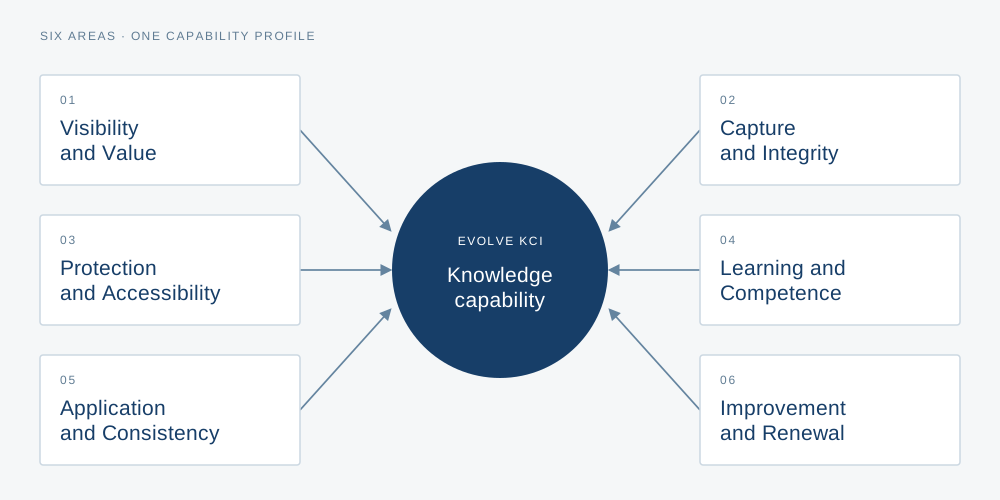
Does the organisation know what knowledge matters, who possesses it and where capability coverage is weak?
The Evolve Knowledge Capability Index, or Evolve KCI, is a focused assessment of how effectively your organisation identifies, captures, protects, teaches, applies and develops operational knowledge.
Start with a scoped pilot. We agree the operational boundary, evidence requirements, responsibilities and fee before work begins. The methodology is being developed and refined through pilot delivery.
We examine the arrangements behind the operation and how they work in practice. A completed course, a shared file or a matching job title provides context; evidence of usable knowledge and demonstrated competence helps establish actual organisational capability.
Does the organisation know what knowledge matters, who possesses it and where capability coverage is weak?
Is practical knowledge captured accurately enough to support dependable learning and decisions?
Is approved knowledge current, appropriately protected and available to the people who need it?
Does learning produce demonstrated capability, with the time, support and recognition needed to develop it?
Is approved knowledge applied consistently across relevant employees, teams, shifts and locations?
Do experience, failures and successful improvements strengthen the organisation’s approved knowledge?
We agree the assessment boundary, business priorities and proportionate evidence requirements with the client.
Discovery combines structured questions, workplace observation and conversations with relevant employees and managers. Approved documents, operational records, learning information and practical demonstrations can provide supporting evidence where appropriate.
Important findings are checked against more than one source where practicable. We distinguish management accounts, employee experience and demonstrated practice, and follow up unresolved questions before reaching conclusions.
The assessment does not require unrestricted access to confidential processes. Materials are supplied on an authorised basis, and conclusions reflect the scope and evidence available. Missing information is distinguished from demonstrated poor performance.
A generally strong organisation may still depend on one person for a business-critical or safety-critical capability.
Critical Knowledge Exposure makes those dependencies visible alongside the overall KCI profile. Relevant issues include insufficient shift coverage, a long development time, weak learning material or uncertainty about who can actually perform the task.
Headcount suggests coverage across three shifts. In practice, one technician may hold most of the diagnostic expertise needed for difficult failures. Brief handovers may not transfer the reasoning behind successful repairs.
Job-title coverage is not the same as capability coverage.
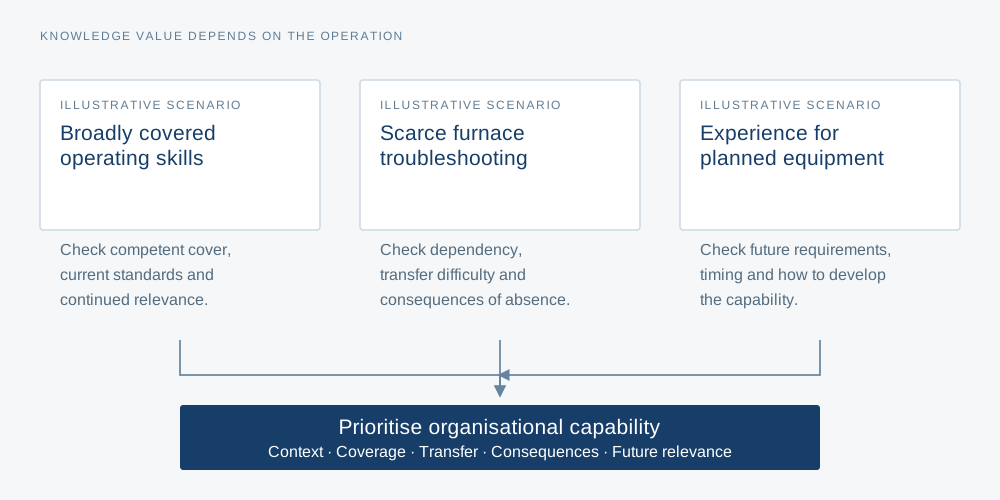
Knowledge Asset Value is the contextual operational and economic value a capability brings through performance, continuity, quality, learning and future development.
We consider operational importance, safety and quality impact, competent coverage, scarcity, transfer difficulty, development time and future relevance. These factors help management prioritise what to preserve and develop.
Common handling skills may already be well covered. Specialist furnace troubleshooting may be scarce and difficult to transfer. Laser-cutting experience brought by a new recruit may become important when planned equipment arrives.
The purpose is to understand what the organisation can reliably achieve because knowledge exists and can be applied. Individual employees are not assigned financial prices.
Mapping connects a capability with the process it supports, competent holders, relevant shifts, validation status, transfer difficulty and development priority. It provides a basis for succession, learning and improvement decisions.
Where reliable operating information exists, management estimates may explore downtime, scrap, external support or delayed capability. Assumptions and ranges remain explicit; a numerical estimate is not required to recognise an important dependency.
An overall knowledge-capability position and a profile across the six areas, identifying strengths, vulnerabilities, knowledge dependencies and Critical Knowledge Exposure within the agreed scope.
Prioritised actions, development opportunities and a review conversation. Recommendations may involve internal client action, an appropriate specialist partner or a separately scoped Evolve service.
Pilot-stage methodology: the framework is being developed and validated. Findings describe the agreed scope and available evidence; the service is not presented as an accredited certification or an established sector benchmark. Purchasing implementation services does not determine the assessment outcome.
Tell us which operation or business challenge you would like to understand. We will agree a useful scope, evidence requirements and fee before work starts.