A dependable learning process.
A protected organisational memory.
The Factory Learning System, or FLS, turns useful experience into approved knowledge, relevant learning and demonstrated competence. The Evolve Knowledge Vault, or EKV, is the knowledge and learning environment that supports the process.
Learning becomes part
of normal factory operations.
Production pressure, staffing gaps and brief handovers can interrupt the transfer of valuable experience. A managed learning system gives that work an owner, an agreed capacity and a way to check whether it succeeds.
The starting point is the factory’s full base of knowledge: existing procedures, practical judgement, supplier expertise, customer requirements, new recruits and lessons from defects and breakdowns.
We identify useful knowledge, establish whether it is reliable and make it available to the appropriate people through controlled learning. The process continues after the first capture exercise.
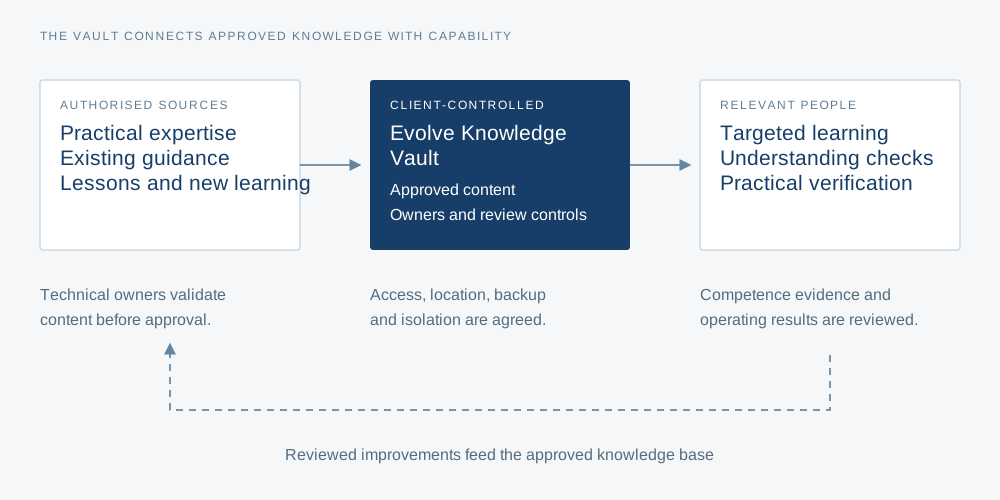
Knowledge Asset Owners and responsible managers validate technical content. Employee experience and operating results then help them review and improve the approved method.
Make room to develop
the people doing the work.
Development needs an agreed place in the production plan. Small groups or individual employees can be released for scheduled learning while the operation maintains suitable cover.
The capacity is agreed around the workforce, shifts and business needs. For example, a client might explore four hours of structured learning per employee each month; this would be a planning choice to assess, not a universal requirement.
Sessions can cover relevant changes, refresher learning, cross-training, supervised practice, knowledge contribution and competence checks. Missed sessions are rescheduled, with outstanding learning visible to the people responsible.
Learning is targeted. A furnace update reaches the loaders, supervisors and managers who need it, through the same approved explanation. Understanding is checked rather than inferred from a message being sent.
Attendance records participation.
Practice reveals capability.
The evidence needed depends on the task. A minor information update may need a short understanding check; complex setup or fault diagnosis may require supervised practice and observed performance.
A development pathway can distinguish recognising a task, assisting, performing with supervision, working independently and becoming able to teach, diagnose or improve it. Task-specific standards are agreed with the responsible technical owners.
Experienced employees also need a meaningful route to develop. Operational Mentor, Learning Champion, Knowledge Asset Owner and technical trainer are possible roles that recognise expertise while helping it reach others.
We also examine how learning and teaching are recognised: what incentives exist, whether they are fixed or flexible, whether employees understand them and whether qualifying contributions receive recognition in practice.
The right knowledge.
For the right people.
With understanding verified.
The Vault brings approved operational knowledge together with the learning and competence records that make it useful.
Its content may include practical demonstrations, visual instructions, troubleshooting knowledge, defect-recognition examples, expert interviews and lessons from improvement. Simulations and virtual reality resources can be included where appropriate.
Every important knowledge asset needs an identifiable owner, an approved location, a defined audience and a review arrangement. Only validated content enters the approved collection; new contributions and proposed changes await the appropriate review.
Relevant material is assigned through scheduled development and connected with checks of understanding or competence. This keeps organisational memory connected to the work people perform.
Protection matched to the knowledge
We classify material by sensitivity and permitted use. General guidance and proprietary process settings may need different access arrangements. Client-controlled local storage, encryption, backup or isolated infrastructure can form part of the agreed design.
Configured around the operation
The Vault is a client-specific knowledge and learning environment being developed through pilot projects. Software, administration, access controls and specialist integration are scoped around the organisation’s needs; there is no claim that one platform fits every factory.
Protecting client knowledge is part of the system.
Client documents, proprietary procedures, technical settings and sensitive operational knowledge remain under the client’s ownership and control. Storage, access, backup and isolation are agreed around the organisation’s requirements.
Generic Evolve methodology, software components and independently developed learning materials remain Evolve Cybernetics intellectual property. Client-specific materials are governed by the agreement under which they are created. Research, external model training or any wider use of authorised client knowledge requires a separate, clearly defined agreement.
Practise the decision.
Understand the consequences.
Interactive learning, physical simulation and virtual reality can help employees practise situations that are difficult to reproduce safely or consistently in live production.
Potential applications include hazard recognition, product handling, defect identification, setup, troubleshooting and abnormal operating conditions. A scenario can offer feedback and repeated practice before the learner returns to the real task.
The learning method must suit the capability. The design considers the operational context, intended learning, technical validity and how practical competence will subsequently be verified.
Custom simulation, virtual reality development and equipment provision are prospective, separately scoped capabilities. Delivery depends on a suitable technical solution, feasibility and agreed specialist support.
Discuss learning support and deliveryConnect learning with
operational performance.
Useful measures may include competent shift coverage, time to develop independent operators, setup consistency, breakdown recovery, handling damage, first-pass yield and the reliability of defect records. The choice depends on the operational problem and the evidence available.
We agree a baseline and review outcomes without assuming every change has a single cause. Resilience, succession cover and capability for planned equipment can also matter before they produce an immediate saving.
Start with a scoped pilot. We agree the operational boundary, evidence requirements, responsibilities and fee before work begins. The methodology is being developed and refined through pilot delivery.
Establish a learning system
your factory can sustain.
Begin with a priority operation, its knowledge owners and a practical learning requirement.